
Crude Oil Prices in Pakistan Today: Brent & WTI Rates in PKR
The current crude oil prices in Pakistan are approximately $106-107 per barrel for Brent and $93-94 per barrel for WTI. When converted to Pakistani Rupees at the current rate, this amounts to around PKR 25,580 for Brent and PKR 23,770 for WTI, translating to about PKR 161 and PKR 149.5 per litre, respectively. Recent price increases are linked to tensions in the Middle East and shipping disruptions. Consequently, petrol is priced at Rs. 379.31 per litre and High-Speed Diesel at Rs. 390.11 per litre. The article outlines the significance of crude oil imports for Pakistan and the distinction between crude oil and petrol prices. It offers insights into fuel price calculations, historical trends, and factors affecting costs
Live Crude Oil Prices Today (in PKR)
Since Pakistan buys its crude and refined fuel in US Dollars, the real cost to the country is best understood in Pakistani Rupees. Using the current interbank rate of roughly Rs. 277.5 per US Dollar:
Crude Oil Benchmark | USD/Barrel | PKR/Barrel | PKR/Litre | Recent Trend |
Brent Crude | $106.50 | PKR 29,500 | PKR 185.5 | Rising over the past several sessions |
WTI Crude | $93.50 | PKR 25,900 | PKR 163 | Tracking Brent higher |
- The figures presented are based on live international benchmark prices from around August 19–20, 2026, and an approximate USD/PKR exchange rate of 278.
- Crude oil is priced using two main benchmarks: Brent Crude (international) and WTI (US). Brent is used for pricing across the Middle East and Asia, while WTI reflects US supply and demand.
- The PKR prices quoted are derived from the dollar prices on exchanges (ICE for Brent and NYMEX for WTI) and are not official prices for Pakistan, as the country does not trade crude oil futures domestically.
- A barrel equals approximately 158.987 litres.
- The PKR equivalent for 1 barrel is approximately PKR 25,580 for Brent and PKR 23,770 for WTI.
- The per-litre prices calculated from these figures are approximately PKR 161.0 for Brent and PKR 149.5 for WTI. These values represent raw crude and do not reflect fuel prices at the pump due to additional costs involved.
Petrol Prices in Pakistan Today
The government notifies fuel prices in Pakistan based on OGRA’s pricing recommendation. Here is the latest snapshot of retail fuel prices:
Current Fuel Ratesموجودہ ایندھن کی قیمتیں
- Petrolپیٹرول PKR 379.31 /Litreلیٹر
- High Speed Dieselہائی سپیڈ ڈیزل PKR 390.11 /Litreلیٹر
- High Octaneہائی آکٹین PKR 415.00 /Litreلیٹر
- Light Dieselلائٹ ڈیزل PKR 267.27 /Litreلیٹر
- Kerosene Oilمٹی کا تیل PKR 326.75 /Litreلیٹر
Fuel prices in Pakistan have shown very frequent revisions in July 2026, moving from the traditional fortnightly review (1st and 16th of each month) toward much closer monitoring, with some weeks seeing multiple adjustments because of volatile international crude prices and currency movement. Always verify the latest number on the day you are reading this, since rates can shift with little notice during periods of global market volatility.
Brent Crude Price in Pakistan Today
- Brent crude prices are currently trading between $105-108 per barrel, influenced by Middle East supply concerns.
- The price per barrel converts to approximately PKR 29,100–29,900, or PKR 183–188 per litre.
- Recent trends show upward movement in Brent prices due to geopolitical risks.
- Brent crude is significant for Pakistan as it serves as the benchmark for pricing crude and refined products imported by the country.
- Pakistan’s energy import economics are often tied to Brent and regional benchmarks, reflecting the impact of global events on import costs.
- Changes in Brent prices do not directly translate to immediate changes in retail petrol prices in Pakistan.
WTI Crude Oil Price in Pakistan
WTI crude is trading at $92–95 per barrel, which translates to approximately PKR 25,500–26,300 per barrel or PKR 160–165 per litre.
Feature | Brent | WTI |
Benchmark region | International (North Sea) | U.S. (Cushing, Oklahoma) |
Market | Global reference price | Primarily U.S.-focused |
Typical price today | $106.50/barrel | $93.50/barrel |
Relevance to Pakistan | Primary international reference | Secondary global reference |
Brent generally trades at a premium to WTI, with the spread widening during regional supply shocks that affect international oil more than US production, explaining the recent increase in the spread.

Crude Oil Price Calculator for Pakistan
Crude Oil Price Conversion Formulas
Use these quick-reference formulas to work out your own numbers as prices change.
| Conversion | Formula | Example (Brent at $92, PKR 278/USD) |
|---|---|---|
| USD → PKR | USD price × exchange rate | $92 × 278 = PKR 25,576 |
| Barrel → Litre | Barrel price ÷ 158.987 | PKR 25,576 ÷ 158.987 = PKR 160.87/litre |
| Barrel → PKR | Same as USD → PKR | PKR 25,576/barrel |
| Litre → PKR | Barrel PKR ÷ 158.987 | PKR 160.87/litre |
| % Change | (New price − Old price) ÷ Old price × 100 | ($92 − $91.19) ÷ $91.19 × 100 ≈ +0.9% |
How to Calculate Crude Oil Price in PKR
Crude oil price in PKR = USD price × USD/PKR exchange rate
To find the PKR price of oil, multiply the Brent or WTI dollar quote by the USD/PKR rate. Oil prices depend on global factors, while the rupee is affected by Pakistan's market, which can cause PKR fluctuations even if dollar prices remain stable.
How Much Crude Oil Is in One Barrel?
A standard oil barrel equals 158.987 liters (42 US gallons). This measurement is the internationally accepted unit for crude oil trading and is used for converting per-barrel prices to per-liter figures.
Historical Crude Oil Prices in Pakistan
- 1-Year Price Range: Brent crude has fluctuated from approximately $58.66/barrel (December 2025) to $120.88/barrel (April 2026), influenced by geopolitical risks and OPEC+ decisions. WTI has generally followed a similar pattern, trading slightly below Brent.
- 30-Day Upward Trend: Over the past month, crude prices have increased, with Brent rising to the low 90sandWTItothemid-80s, primarily due to renewed tensions in the Middle East and incidents near the Strait of Hormuz.
Key Factors Impacting Prices
- Late 2025 saw weakness due to high supply and reduced demand.
- Spring 2026 experienced a price spike driven by tighter OPEC+ management and geopolitical risks.
- Recent months have seen climbing prices due to shipping disruptions and regional conflicts.
Recurring Themes: OPEC+ production policies, Middle East geopolitical risks, and demand shifts, particularly from China and the US, have been central to price movements.
Petrol Price History in Pakistan
Price Historyقیمتوں کی تاریخ
| Dateتاریخ | Petrolپیٹرول | Diesel (HSD)ڈیزل (ایچ ایس ڈی) | High Octaneہائی آکٹین | Light Dieselلائٹ ڈیزل | Keroseneمٹی کا تیل |
|---|---|---|---|---|---|
| 22 October 2026 | Rs 379.31 | Rs 390.11 | Rs 415.00 | Rs 267.27 | Rs 326.75 |
| 21 October 2026 | Rs 382.02 | Rs 389.80 | Rs 415.00 | Rs 267.46 | Rs 326.75 |
| 20 October 2026 | Rs 381.14 | Rs 389.27 | Rs 415.00 | Rs 267.46 | Rs 326.75 |
| 17 October 2026 | Rs 386.30 | Rs 396.96 | Rs 415.00 | Rs 266.41 | Rs 326.75 |
| 16 October 2026 | Rs 390.23 | Rs 396.96 | Rs 415.00 | Rs 266.41 | Rs 330.14 |
| 16 October 2026 | Rs 390.23 | Rs 396.96 | Rs 415.00 | Rs 266.41 | Rs 330.14 |
| 15 October 2026 | Rs 393.86 | Rs 396.65 | Rs 415.00 | Rs 266.41 | Rs 330.14 |
| 15 October 2026 | Rs 393.86 | Rs 396.65 | Rs 415.00 | Rs 266.41 | Rs 330.14 |
| 14 October 2026 | Rs 392.66 | Rs 396.82 | Rs 415.00 | Rs 266.41 | Rs 330.14 |
| 13 October 2026 | Rs 395.37 | Rs 396.85 | Rs 415.00 | Rs 266.41 | Rs 330.14 |
| 10 October 2026 | Rs 398.30 | Rs 396.24 | Rs 410.00 | Rs 272.29 | Rs 329.52 |
| 09 October 2026 | Rs 398.96 | Rs 395.72 | Rs 410.00 | Rs 272.29 | Rs 329.52 |
| 08 October 2026 | Rs 396.65 | Rs 394.94 | Rs 410.00 | Rs 272.29 | Rs 329.52 |
| 07 October 2026 | Rs 394.83 | Rs 395.85 | Rs 410.00 | Rs 272.29 | Rs 329.54 |
| 06 October 2026 | Rs 393.64 | Rs 397.76 | Rs 410.00 | Rs 272.29 | Rs 329.54 |
| 03 October 2026 | Rs 392.76 | Rs 399.64 | Rs 400.00 | Rs 277.19 | Rs 321.56 |
| 02 October 2026 | Rs 390.66 | Rs 399.34 | Rs 400.00 | Rs 277.19 | Rs 321.56 |
| 01 October 2026 | Rs 387.40 | Rs 400.35 | Rs 400.00 | Rs 277.19 | Rs 321.56 |
| 30 September 2026 | Rs 387.54 | Rs 402.24 | Rs 400.00 | Rs 277.19 | Rs 321.56 |
| 29 September 2026 | Rs 389.03 | Rs 404.97 | Rs 400.00 | Rs 277.19 | Rs 321.86 |
| 26 September 2026 | Rs 391.30 | Rs 408.53 | Rs 400.00 | Rs 304.78 | Rs 347.32 |
| 25 September 2026 | Rs 389.28 | Rs 412.12 | Rs 400.00 | Rs 304.78 | Rs 347.32 |
| 24 September 2026 | Rs 390.12 | Rs 414.75 | Rs 400.00 | Rs 304.78 | Rs 347.32 |
| 23 September 2026 | Rs 392.05 | Rs 418.96 | Rs 400.00 | Rs 304.78 | Rs 347.32 |
| 23 September 2026 | Rs 392.05 | Rs 418.95 | Rs 400.00 | Rs 304.78 | Rs 347.32 |
| 22 September 2026 | Rs 393.75 | Rs 422.08 | Rs 400.00 | Rs 304.78 | Rs 317.32 |
| 19 September 2026 | Rs 389.14 | Rs 424.04 | Rs 400.00 | Rs 304.78 | Rs 347.32 |
| 18 September 2026 | Rs 390.79 | Rs 424.92 | Rs 400.00 | Rs 279.55 | Rs 324.35 |
| 17 September 2026 | Rs 391.22 | Rs 421.45 | Rs 400.00 | Rs 279.55 | Rs 324.35 |
| 16 September 2026 | Rs 384.34 | Rs 415.83 | Rs 395.00 | Rs 279.55 | Rs 324.35 |
| 15 September 2026 | Rs 380.24 | Rs 409.42 | Rs 395.00 | Rs 279.55 | Rs 32.35 |
| 12 September 2026 | Rs 375.82 | Rs 403.32 | Rs 380.00 | Rs 267.06 | Rs 307.00 |
| 11 September 2026 | Rs 370.80 | Rs 398.04 | Rs 380.00 | Rs 267.06 | Rs 307.00 |
| 10 September 2026 | Rs 367.75 | Rs 392.67 | Rs 380.00 | Rs 267.06 | Rs 307.00 |
| 09 September 2026 | Rs 364.35 | Rs 385.95 | Rs 370.00 | Rs 267.06 | Rs 307.00 |
| 08 September 2026 | Rs 358.77 | Rs 381.77 | Rs 370.00 | Rs 267.06 | Rs 307.00 |
| 05 September 2026 | Rs 345.87 | Rs 378.05 | Rs 370.00 | Rs 252.03 | Rs 286.44 |
| 04 September 2026 | Rs 349.00 | Rs 374.31 | Rs 370.00 | Rs 252.03 | Rs 286.44 |
| 03 September 2026 | Rs 346.16 | Rs 372.03 | Rs 370.00 | Rs 252.03 | Rs 286.44 |
| 02 September 2026 | Rs 343.87 | Rs 370.91 | Rs 365.00 | Rs 252.03 | Rs 286.44 |
| 01 September 2026 | Rs 342.79 | Rs 370.41 | Rs 365.00 | Rs 252.03 | Rs 286.44 |
| 29 August 2026 | Rs 342.02 | Rs 371.44 | Rs 365.00 | Rs 269.69 | Rs 303.50 |
| 28 August 2026 | Rs 342.60 | Rs 371.61 | Rs 365.00 | Rs 269.69 | Rs 303.50 |
| 26 August 2026 | Rs 343.10 | Rs 371.80 | Rs 365.00 | Rs 269.69 | Rs 303.50 |
| 25 August 2026 | Rs 341.98 | Rs 370.69 | Rs 355.00 | Rs 261.81 | Rs 300.85 |
| 22 August 2026 | Rs 341.59 | Rs 368.29 | Rs 355.00 | Rs 261.81 | Rs 300.85 |
| 22 August 2026 | Rs 341.59 | Rs 368.29 | Rs 355.00 | Rs 261.81 | Rs 300.85 |
| 21 August 2026 | Rs 337.78 | Rs 364.70 | Rs 355.00 | Rs 261.81 | Rs 300.85 |
| 20 August 2026 | Rs 337.51 | Rs 363.06 | Rs 355.00 | Rs 256.70 | Rs 296.63 |
| 19 August 2026 | Rs 334.54 | Rs 395.69 | Rs 355.00 | Rs 256.70 | Rs 296.63 |
| 18 August 2026 | Rs 331.20 | Rs 390.42 | Rs 355.00 | Rs 249.03 | Rs 289.75 |
| 14 August 2026 | Rs 325.43 | Rs 383.95 | Rs 355.00 | Rs 249.03 | Rs 289.75 |
| 13 August 2026 | Rs 324.98 | Rs 382.79 | Rs 355.00 | Rs 247.82 | Rs 289.87 |
| 11 August 2026 | Rs 325.92 | Rs 382.25 | Rs 350.00 | Rs 256.34 | Rs 301.64 |
| 07 August 2026 | Rs 327.62 | Rs 380.86 | Rs 350.00 | Rs 256.34 | Rs 301.64 |
| 07 August 2026 | Rs 329.82 | Rs 382.36 | Rs 350.00 | Rs 256.34 | Rs 301.64 |
| 06 August 2026 | Rs 333.01 | Rs 383.86 | Rs 350.00 | Rs 256.34 | Rs 301.64 |
| 05 August 2026 | Rs 328.56 | Rs 385.86 | Rs 350.00 | Rs 256.34 | Rs 301.64 |
| 04 August 2026 | Rs 331.95 | Rs 389.93 | Rs 350.00 | Rs 258.84 | Rs 305.22 |
| 01 August 2026 | Rs 336.03 | Rs 392.38 | Rs 350.00 | Rs 259.72 | Rs 306.44 |
| 31 July 2026 | Rs 336.15 | Rs 393.04 | Rs 350.00 | Rs 25.71 | Rs 304.67 |
| 30 July 2026 | Rs 335.06 | Rs 390.62 | Rs 350.00 | Rs 256.04 | Rs 303.63 |
| 29 July 2026 | Rs 335.81 | Rs 388.38 | Rs 350.00 | Rs 255.16 | Rs 303.10 |
| 27 July 2026 | Rs 334.18 | Rs 386.83 | Rs 445.00 | Rs 199.98 | Rs 233.71 |
| 25 July 2026 | Rs 335.18 | Rs 383.46 | Rs 445.00 | Rs 199.98 | Rs 233.71 |
| 24 July 2026 | Rs 331.52 | Rs 378.66 | Rs 445.00 | Rs 199.98 | Rs 233.71 |
| 23 July 2026 | Rs 327.12 | Rs 375.04 | Rs 350.00 | Rs 199.98 | Rs 233.71 |
How Do Crude Oil Prices Affect Petrol Prices in Pakistan?
- The relationship between crude oil prices and petrol prices is complex and indirect.
- Crude oil price changes do not automatically result in immediate changes to petrol prices.
Various factors influence the final petrol price, including:
- Refined-product prices, which can fluctuate independently of crude oil prices.
- Exchange-rate fluctuations that can affect import costs.
- Shipping costs and freight rates influenced by tanker demand.
- Fixed government charges such as the petroleum levy and taxes.
- Dealer and distributor margins that are periodically adjusted.
- A pricing mechanism that uses a rolling average of prices, resulting in a lag.
- Petrol prices can rise even if crude oil prices fall due to currency depreciation or increased government levies.
- The distinction between crude oil price, refined petrol price, and retail petrol price is crucial, as each is influenced by different market forces.
What Determines Petrol and Diesel Prices in Pakistan?
- Pricing Benchmark: Petrol and diesel prices in Pakistan are primarily based on international refined-product prices, referencing Persian Gulf or Platts-based pricing.
- Exchange Rate Impact: The rupee’s value against the USD affects the local cost of fuel; a weaker rupee increases costs, while a stronger rupee can help mitigate rising prices.
- Taxes and Levies: The final fuel price includes government-determined taxes like the General Sales Tax (GST) and the Petroleum Development Levy (PDL), which are updated periodically.
- Additional Costs: Factors like freight, insurance, import premiums, port handling, and dealer margins add to the base price before fuel is available at stations.
- Pricing Policy: Pakistan has adopted a daily pricing mechanism, allowing the Oil and Gas Regulatory Authority (OGRA) to calculate and notify fuel prices based on a rolling average of international benchmarks for quicker adjustments.
Factors Affecting Crude Oil Prices
- OPEC+ Production Decisions: OPEC+ periodically adjusts output targets, with tighter supply raising prices and higher output lowering them.
- Geopolitical Conflicts: Tensions in oil-producing regions can increase price risk premiums due to the potential for supply disruptions.
- Global Oil Demand: Economic growth or slowdown affects global oil consumption, particularly from major economies like the US, China, and India.
- U.S. Oil Production and Inventories: Weekly inventory data and shifts in US shale production influence WTI pricing and the global market.
- China’s Oil Demand: Changes in China’s industrial activity and oil stockpiling significantly impact global prices.
- Shipping and Supply Disruptions: Issues like tanker rerouting and chokepoint congestion can restrict supply, affecting prices even without production cuts.
- U.S. Dollar Strength: A stronger dollar can reduce demand for oil priced in dollars, impacting prices negatively, influenced by Federal Reserve policies.
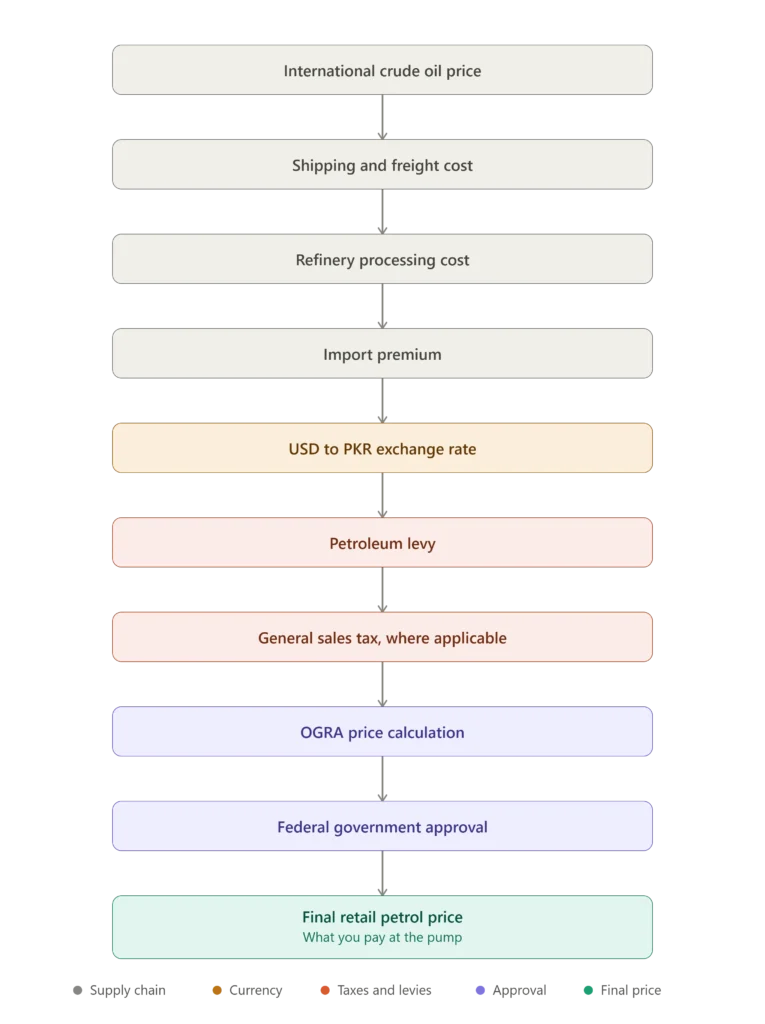
How International Crude Oil Becomes Petrol in Pakistan
Understanding the journey from a barrel of crude oil to the petrol you pump into your car helps explain why prices move the way they do:
Crude Oil Price Forecast in Pakistan
Short-Term Outlook: Prices may remain volatile due to geopolitical risks, Middle East shipping developments, US inventory reports, and market sentiment.
Medium-Term Outlook: Key factors affecting prices will include OPEC+ production policy, global economic growth, demand trends, and refinery activity.
Factors That Could Increase Petrol Prices
- Escalation of Middle East tensions or shipping disruptions
- Weaker Pakistani rupee
- OPEC+ tightening supply
- Higher government levies or dealer margins
Factors That Could Decrease Petrol Prices
- De-escalation of regional conflict and normalized shipping
- OPEC+ increasing output
- Stronger rupee
- Softer global demand, particularly from China
Pakistan vs International Fuel Prices
Country | Petrol Price (PKR equivalent/litre) |
Pakistan | Rs. 379.31 |
Saudi Arabia | Lower, due to domestic subsidies |
UAE | Moderate, partially subsidized |
India | Generally higher due to heavier taxation |
Bangladesh | Comparable, subject to local tax policy |
Sri Lanka | Historically volatile, tied to import costs |
Pakistan Fuel Taxes and Petroleum Levy Explained
Components of Petrol Price in Pakistan
| Component | Approx. Price (Rs./Litre) | Role in Final Price |
|---|---|---|
| Petroleum Levy (PDL) | Rs. 80.00/litre on petrol, Rs. 70.82/litre on HSD | Fixed per-litre government charge, the single largest and most flexible revenue tool |
| General Sales Tax (GST) | 0–18%, applied when active | Applied on the cumulative value where relevant |
| Dealer Margin | Rs. 8.64/litre | Fixed commission paid to retail fuel station owners |
| OMC Margin | Rs. 7.87/litre | Margin retained by Oil Marketing Companies (PSO, Shell, Attock, Total PARCO, etc.) |
| IFEM | Rs. 4–7/litre, varies by fuel | Covers uniform transport cost from Karachi to Gilgit |
| Customs Duty | Varies by product | Applied to certain imported petroleum products |
| Climate Support Levy | Rs. 5.00/litre | Environmental levy on select fuel types |
Important: Taxes and margins alone add up to roughly Rs. 100–110 per litre on top of the ex-refinery price – meaning that on a Rs. 333.01/litre pump price, well over 30% is government charges and margins, not crude oil cost itself.
Provinces Most Affected by Fuel Price Changes
- Punjab: Largest fuel consumption base; transport and agriculture sectors are highly sensitive to diesel prices.
- Sindh: Karachi’s port and industrial activity make it a key import and distribution hub.
- Khyber Pakhtunkhwa (KPK): Higher transport costs due to longer supply routes from depots.
- Balochistan: Sparse fuel station network means price changes are felt strongly in remote areas.
- Azad Jammu & Kashmir (AJK): Mountainous terrain adds to transport and supply costs.
- Gilgit-Baltistan: Among the most affected regions due to long-distance fuel transport and seasonal road access.
Economic Impact of Fuel Price Changes
- Transportation: Bus and rickshaw fares typically rise within days of a diesel or petrol increase.
- Food Prices: Higher diesel costs raise the price of transporting produce, pushing up grocery bills.
- Electricity: Furnace oil-based power generation costs can rise, indirectly affecting electricity tariffs.
- Agriculture: Diesel powers tractors and irrigation pumps, so farming input costs rise with fuel prices.
- Businesses: Delivery, logistics, and manufacturing costs increase, often passed on to consumers.
- Inflation: Fuel is a core component of Pakistan’s inflation basket, meaning petrol hikes tend to show up in the headline inflation rate within weeks.
- Imports: A weaker Rupee combined with rising crude prices increases Pakistan’s overall import bill.
- Exports: Higher transport and production costs can reduce the competitiveness of Pakistani exports
Conclusion
Crude oil prices in Pakistan are currently high, with Brent Crude priced between Rs. 27,470 and Rs. 27,750 per barrel and WTI Crude priced between Rs. 24,975 and Rs. 25,250 per barrel. Domestic petrol prices are approximately Rs. 379.31 per litre, and High-Speed Diesel is around Rs. 390.11 per litre as of 22 October 2026. Key factors influencing these prices include international crude benchmarks, the USD/PKR exchange rate, the Petroleum Levy, and government taxes. Future petrol price changes will depend on developments in the Middle East and the stability of the Rupee. It’s advisable to check the latest OGRA notification for updates on fuel prices before making travel or business decisions.
Frequently Asked Questions
What is the crude oil price in Pakistan today?
As of October 15, 2026, Brent crude is trading around $106.50/barrel and WTI around $93.50/barrel based on the current USD/PKR rate of about 277.15.
What is the price of 1 barrel of crude oil in Pakistan?
It’s calculated by multiplying the live USD benchmark price (Brent or WTI) by the current USD/PKR exchange rate, currently around PKR 25,580/barrel for Brent and PKR 23,770/barrel for WTI.
What is the price of 1 litre of crude oil in Pakistan?
Divide the PKR per-barrel price by 158.987 (litres in a standard barrel). At today’s rates, that’s roughly PKR 161/litre for Brent and PKR 149.5/litre for WTI, in raw crude terms.
What is Brent crude oil price today?
Brent is trading at approximately $104–107 per barrel as of October 14, 2026.
What is WTI crude oil price today?
WTI is trading at approximately $91–94 per barrel as of October 14, 2026.
Is crude oil the same as petrol?
No. Crude oil is the unrefined raw material extracted from the ground; petrol (gasoline) is a refined product made from crude through processing at a refinery, with taxes and margins added before it reaches consumers.
Does crude oil price determine petrol price in Pakistan?
It’s one major input, but not the only one. Refined-product prices, the exchange rate, freight, taxes, the petroleum levy, and dealer margins all factor into the final retail price.
Why does petrol price remain high when crude oil falls?
Because Pakistan’s pricing mechanism uses a rolling average of recent international prices rather than the live spot rate, and because the rupee, taxes, freight, and margins can move independently and offset a crude-price decline.
Which crude oil benchmark is important for Pakistan?
Brent is the primary international reference, given its role in pricing crude and related products across the Middle East and Asia, though Pakistan’s actual import prices are usually tied to refined-product benchmarks rather than crude alone.
How is crude oil price converted from USD to PKR?
Multiply the USD/barrel price by the current USD/PKR exchange rate. To get a per-litre figure, divide the resulting PKR/barrel figure by 158.987.
Crude Oil Price Data Sources and Methodology
The text outlines the sources of market data for Brent and WTI benchmark prices, obtained from international commodity market providers and financial news outlets such as Investing.com, OilPrice.com, and Trading Economics. It also specifies that domestic petrol and diesel prices in Pakistan are based on official notifications from the Petroleum Division and OGRA, as well as the USD/PKR exchange rate from interbank market data and the State Bank of Pakistan. The calculation for the PKR price involves converting the USD price per barrel to PKR per barrel using the exchange rate, and then dividing by 158.987 to get the price per litre.
Important Disclaimer
The crude oil prices in the article represent only the international benchmark value for reference and are not Pakistan’s official retail petrol or diesel prices. Official prices are set by OGRA and the Petroleum Division based on various factors. Always refer to the latest OGRA notification or press release for current prices. The figures provided are indicative as of August 2026; for real-time pricing, consult live market data sources.