How to Check Petrol Quality in Pakistan (2026): Spot Fake and Adulterated Fuel
Filling your tank in Pakistan may raise concerns about petrol quality, especially after the major adulteration scam uncovered in 2026. To protect yourself, you can conduct simple home tests instead of relying on laboratory results, as formal testing offers definitive proof. The guide discusses how adulteration occurs, signs of potential issues in your vehicle, and five methods for checking petrol quality to avoid engine damage. While DIY checks like visual inspections and density tests can be helpful, they are not conclusive. Authorities perform formal testing at various supply chain points to ensure fuel quality.
Quick answer: Petrol quality can be screened through visual inspection, a filter-paper test and, where appropriate, density testing. These methods can raise suspicion but cannot prove adulteration. Pakistan’s petroleum-quality system includes formal testing of products at refineries, depots and retail outlets.
What Is Petrol Adulteration and Why Does Petrol Quality Matter?
Adulteration in fuel involves mixing cheaper substances like kerosene oil and industrial solvents into petrol to increase profits. Common adulterants in Pakistan include:
- Kerosene oil: Often mixed at 10-20% to avoid detection.
- LAHS (light aliphatic hydrocarbon solvent): A cheap industrial solvent linked to a major scam, failing to meet the required RON 92 specification.
- Low-octane fuel with additives: In 2017, Honda Atlas raised concerns about fuel containing excessive manganese additives.
The issue of adulteration is most severe outside major cities due to weaker monitoring, but complaints arise even from cities like Karachi and Lahore.
Contamination, on the other hand, is often accidental and involves unwanted materials entering genuine fuel, such as:
- Water from leaks or condensation
- Dirt and sediment from old tanks
- Other substances from shared tankers or lines
- Storage issues like rust or degraded fuel
Fake vs adulterated vs contaminated petrol
| Term | Meaning |
| Fake fuel | Fuel misrepresented or sold as something it isn’t |
| Adulterated fuel | Petrol mixed with another substance |
| Contaminated fuel | Petrol containing unwanted contaminants |
| Low-quality fuel | Fuel that does not meet applicable specifications |
Fuel quality can be compromised by adulteration or contamination, so it’s important to use accurate terms for specific issues.
How to Check Petrol Quality at a Petrol Pump in Pakistan
Choose a Reputable Petrol Station
Select authorized outlets that are subject to regulatory inspections and controls to lower your risk.
Check the Dispenser
Ensure the meter starts at zero, verify the displayed quantity while fueling, confirm the price per litre, and keep the receipt for evidence.
Inquire About Fuel-Quality Testing
Ask the station manager or oil marketing company about their fuel quality testing procedures, which should comply with official standards.
Perform a Filter-Paper Test
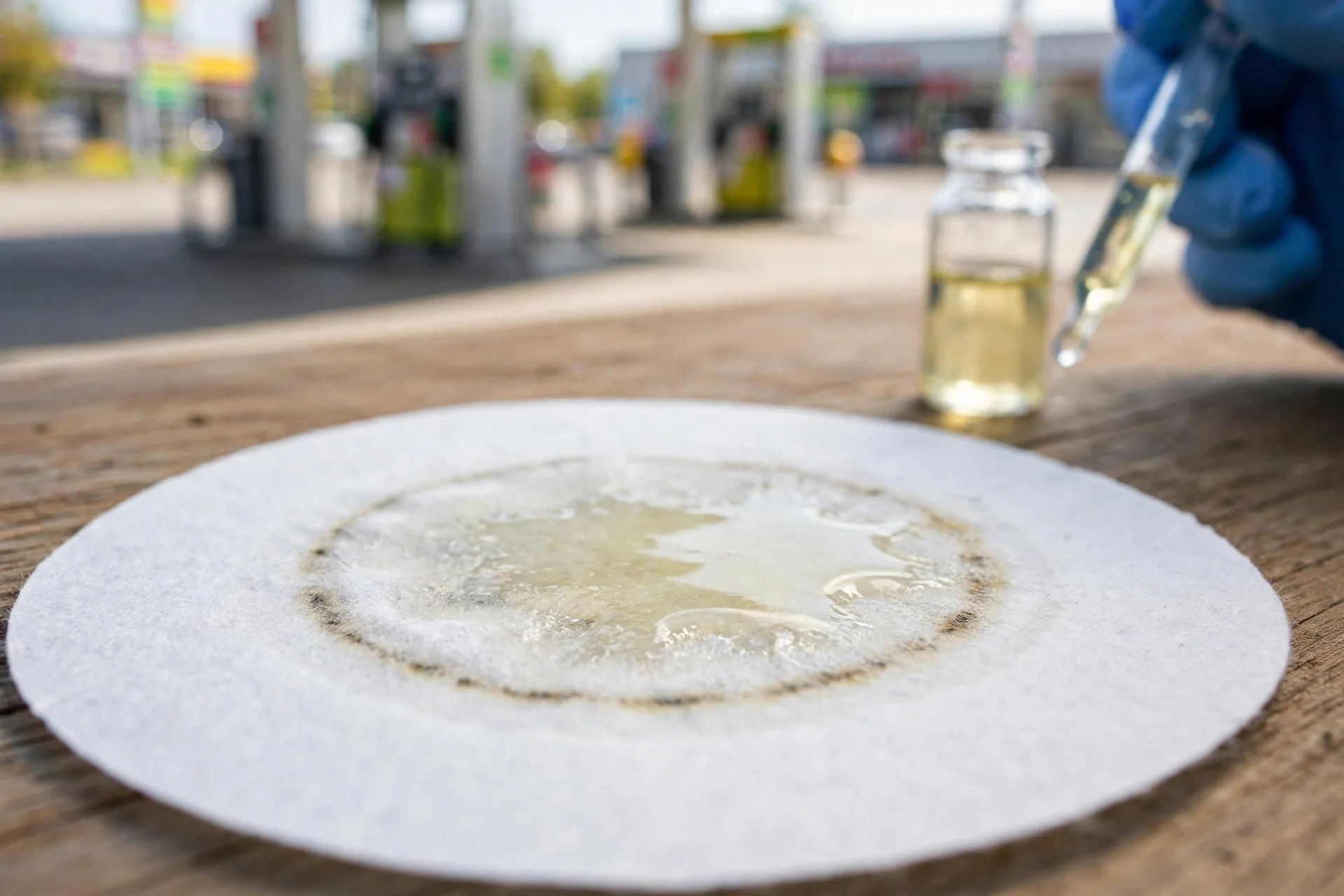
Conduct a simple test by observing a petrol sample on clean paper; genuine petrol evaporates with minimal residue.
Consider Density Testing
Use a hydrometer and temperature readings for density testing, understanding it requires proper procedure and reference values for accurate assessment.
How to Do the Petrol Filter Paper Test
Materials Needed
- Clean white filter paper
- Small petrol sample
- Safe testing environment (outdoors or well-ventilated)
Procedure
- Ensure a safe environment away from ignition sources.
- Place filter paper on a non-flammable surface.
- Use a clean dropper to place a small drop of petrol on the paper.
- Observe the drop’s evaporation and spreading without bringing the paper near your face.
- Allow any vapors to disperse before disposing of the paper responsibly.
Observations to Make
- Rate of evaporation
- Visible residue left after drying
- Unusual marks or discoloration
- Persistent oily residue
Interpretation
- Stains indicate potential issues but don’t provide specific identification or quantity.
- A clean result doesn’t guarantee fuel quality.
Limitations
- The test doesn’t identify all adulterants.
- It doesn’t measure octane or determine full specification compliance.
- It cannot replace laboratory testing.
The test primarily shows whether a sample leaves visible residue, which may warrant further investigation.
How to Check Petrol Density in Pakistan
- Petrol Density: Defined as the weight of a given volume of petrol, usually measured in kg/L or kg/m³. It varies based on its hydrocarbon blend and can be affected by additional liquids.
- Equipment Needed: A hydrometer for light petroleum products, a tall measuring container, and a thermometer to measure temperature.
- Importance of Temperature: Density changes with temperature, requiring corrections to readings based on a standard reference temperature (commonly 15°C) for accurate comparisons against specifications.
- Density Testing Process: Involves measuring the sample’s temperature, taking a hydrometer reading, correcting it to the reference temperature, and comparing it with the relevant specification in Pakistan.
- Adulteration Indication: An abnormal density result does not prove petrol is adulterated, but it signals the need for further investigation because of potential errors or blend variations.
Can You Identify Bad Petrol by Colour or Smell?
Petrol colour and smell tests are popular because they are free and quick.
- Petrol colour is not a reliable indicator of quality due to variations in dyes and the possibility of harmful colourless adulterants.
- While petrol has a characteristic smell, unusual odors are subjective and cannot pinpoint specific issues; inhaling fumes is unsafe.
- Visual checks can help identify obvious problems like water or debris but cannot assess important properties like octane or chemical composition.
How to Check Petrol for Water or Other Contamination
Signs of Possible Contamination
- Unusual vehicle behavior after refueling.
- Visible separation or contamination, such as water settling in fuel.
- Repeated engine issues after filling at the same station.
Problems Caused by Water in Petrol
- Combustion issues lead to misfires and rough engine running.
- Promotes corrosion and clogs filters in the fuel system.
- Significant amounts can cause stalling or hard starting.
Caution on Symptoms
- Vehicle symptoms can suggest a fuel problem but do not prove adulterated petrol is the cause.
Signs Your Car or Bike May Have Received Poor-Quality Petrol
Common signs after refueling:
- Unusual hesitation when accelerating
- Rough running or shaking at idle
- Difficulty starting
- Reduced performance or power
- Unexpected changes in fuel economy
- Engine knocking or other abnormal operation
Are these symptoms proof of bad petrol?
No. These symptoms overlap with many ordinary mechanical issues, including:
- Worn spark plugs
- Clogged filters
- Dirty or failing injectors
- Ignition problems
- General engine condition
- Driving conditions, such as heavy traffic, heat or short trips
If symptoms began right after refueling, that timing is worth recording. It is still a clue, not a verdict.
Petrol Quality Standards and Testing in Pakistan
- Role of HDIP: The HDIP is a national petroleum research body that provides quality testing and laboratory services for petroleum products, working with the Government and OGRA for quality certification. It tests products like gasoline and conducts sampling of imported POL products. Retail outlets are also part of its testing scope.
- Role of Oil Marketing Companies (OMCs): OMCs implement their own quality systems; for example, PSO has a Quality Assurance Department that monitors product quality throughout the supply chain, utilizing mobile vans for random testing at retail outlets. Other OMCs have similar programs.
- Role of Provincial Authorities: In Punjab, the Environmental Protection Agency mandates fuel quality testing at retail outlets under the Punjab Environmental Protection Act 1997, prohibiting the sale of non-compliant gasoline and high-speed diesel, with penalties for violations.
- Mobile Fuel Testing in Punjab: Punjab has introduced mobile fuel testing labs for on-the-spot analysis of fuel, supported by fixed labs for cross-verification.
- Enforcement Example: In April 2026, OGRA fined a filling station owner Rs 110 million and revoked its NOC due to hazardous chemicals found in petrol and diesel after conducting laboratory analysis.
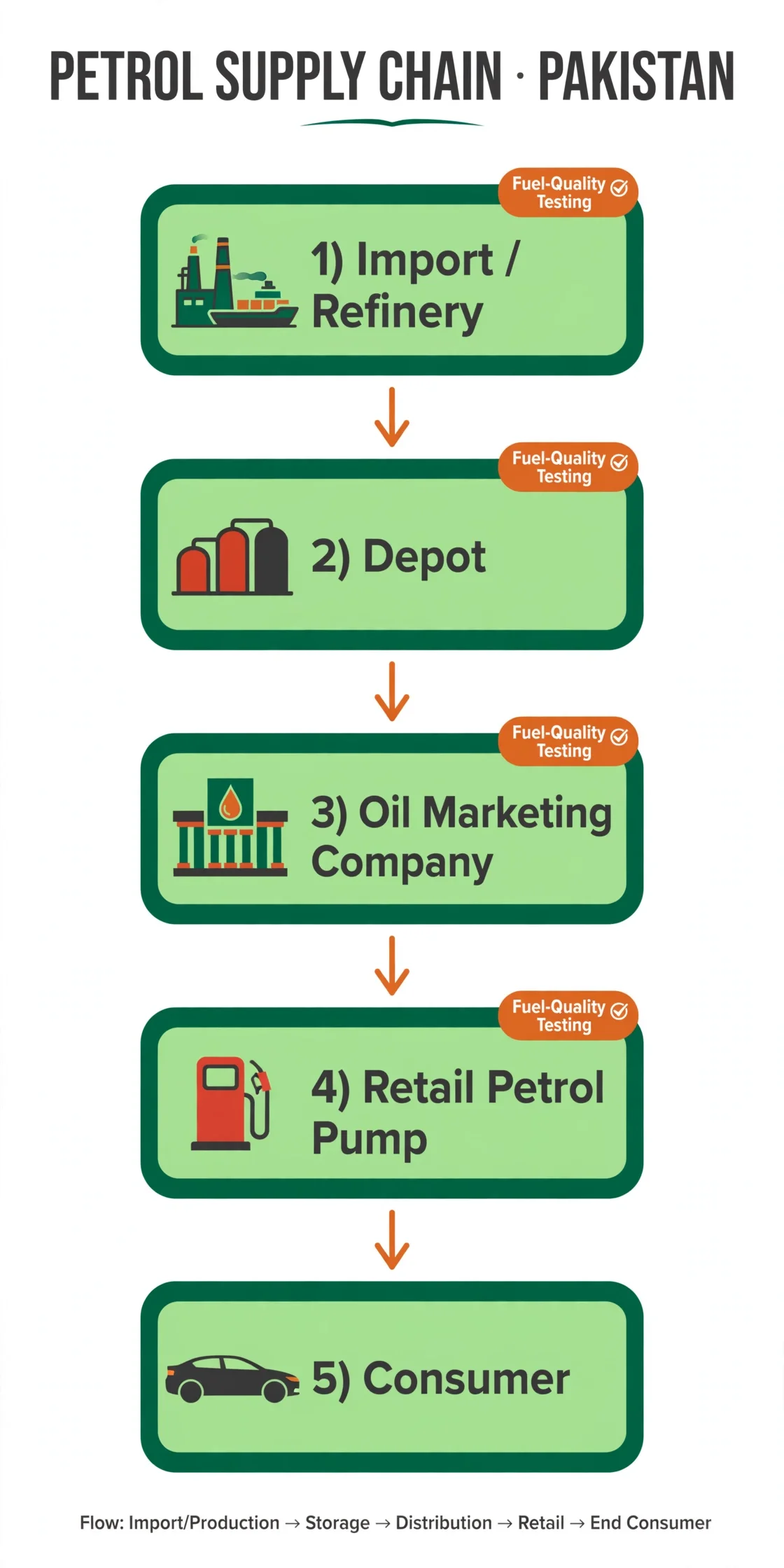
How Petrol Quality Is Tested From Supply Chain to Petrol Pump
The process of quality monitoring for petroleum products occurs at multiple stages: from refineries and ports to depots and retail outlets. Official inquiries involve testing by organizations like OGRA, HDIP, and third-party inspectors at various points in the supply chain. Early detection of issues reduces the amount of substandard fuel reaching vehicles, but consumer vigilance remains important to identify potential gaps in quality assurance.
The 2026 LAHS Scam: Why This Matters More Than Ever
In mid-2026, the Prime Minister’s Office intervened against a large adulteration network following Customs Intelligence reports. Authorities detained 807 tankers, including 160 Iranian transit tankers, at the NLC Dry Port in Quetta for misdeclaring light aliphatic hydrocarbon solvent (LAHS) as an industrial product. Testing revealed that the solvent did not meet OGRA’s Research Octane Number specifications for petrol, leading to a potential Rs 135 billion revenue loss. Officials warned of possible engine damage and increased maintenance costs for consumers using the adulterated fuel. The investigation into the case is ongoing.
How to Check Whether a Petrol Pump Is Authorized
- Authorization is crucial; licensed petrol pumps are regulated, and actions have been taken against unlicensed stations (e.g., Muzaffargarh case with over 135,000 litres stored illegally).
- Branding does not guarantee compliance; an unlicensed pump was identified even under a private oil company.
- Keep transaction evidence like receipts and photos of signage.
- Use official channels for verification; OGRA is the regulator, and its website provides contact information for various regional offices.
- Avoid making accusations against specific stations without evidence.
What to Do If You Suspect Adulterated Petrol
Step 1: Don’t immediately discard evidence
Keep:
- The receipt
- Date and time
- Petrol station name and location
- Pump number, if available
- Fuel grade
- Quantity
- Vehicle details
Step 2: Document the problem
Record:
- Your vehicle’s symptoms and when they began
- Any unusual appearance of the fuel, only if it can be safely observed
- Test results, if you have any, with the method used
Step 3: Ask for appropriate testing
Consumer observations aren’t equivalent to laboratory analysis. If a sample is taken, it should follow proper sampling and chain-of-custody practices. A bottle filled casually can easily be challenged.
Step 4: Contact the appropriate company or authority
The text outlines key entities involved in addressing public grievances and quality assurance regarding fuel. These include:
- OMC (Oil Marketing Company) identified by its brand on fuel pumps.
- OGRA (Oil and Gas Regulatory Authority) has a Consumer Affairs Department for handling public complaints, with regional offices.
- Provincial authorities like EPA Punjab are relevant where applicable.
- HDIP (Hydrocarbon Development Institute of Pakistan) is involved in testing and has a presence in the downstream sector.
Step 5: Seek professional vehicle inspection
If your vehicle develops significant problems, have a qualified mechanic inspect it. Keep their written findings along with your fuel evidence.
What Not to Do When Testing Petrol
Petrol is flammable, and its vapour is harmful. Don’t:
- Taste petrol
- Deliberately inhale fumes
- Perform tests near flames, cigarettes, engines or sparks
- Use unsafe containers such as thin plastic bottles or food containers
- Experiment inside a closed room
- Assume one visual test proves adulteration
Dispose of used paper and leftover fuel responsibly, away from drains and heat.
Petrol Quality Check: Quick Comparison Table
| Method | What it can indicate | Reliability/limitation |
| Visual inspection | Obvious abnormalities such as water or debris | Limited |
| Smell | Unusual characteristics | Limited, subjective |
| Filter paper | Possible residue or abnormality | Screening only |
| Density | Possible specification deviation | Requires correct procedure and temperature correction |
| Laboratory testing | Detailed fuel properties | Most comprehensive |
Petrol Quality Checklist for Pakistani Drivers
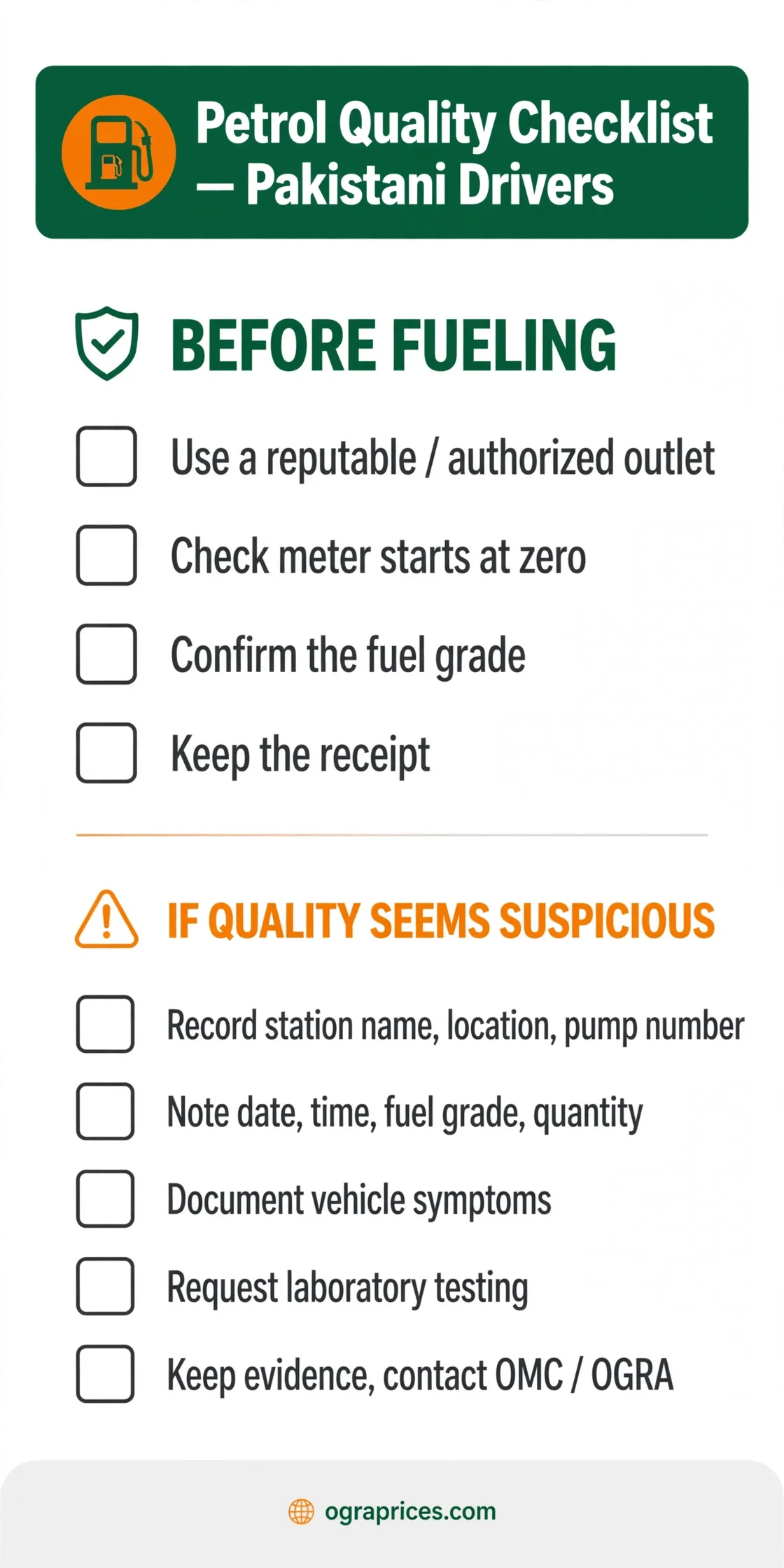
Before fueling
- Use a reputable/authorized outlet
- Check the meter starts at zero
- Confirm the fuel grade
- Keep the receipt
If quality seems suspicious
- Record the station name, location, and pump number
- Note the date, time, fuel grade, and quantity
- Document vehicle symptoms and when they began
- Request appropriate (laboratory) testing
- Keep all evidence and contact the OMC or OGRA
Tip: is checklist ko ek downloadable image/PDF banao — backlink asset banega.
Final Verdict
Fuel checking involves a process similar to a ladder: starting with simple screening, moving to further investigation, and ending with professional testing. Use authorized stations, monitor the meter, retain receipts, and use initial cues like paper tests, smell, and color as prompts for deeper investigation. If you have valid concerns, document everything and report to the OMC or regulator. Definitive conclusions about fuel quality should come from proper technical testing. With petrol prices around Rs 390 per litre in Pakistan, ensure you get genuine fuel. Utilize easy checks like filter paper tests and density checks, and make these habits while filling up at trusted pumps. Reporting bad stations is crucial, as quality fuel impacts both mileage and engine longevity.
Frequently Asked Questions
How can I check petrol quality in Pakistan?
Use screening checks (meter, visual inspection, filter paper, density where appropriate) and rely on laboratory testing for definitive answers. Choose authorized stations and keep receipts.
How can I identify adulterated petrol?
Reliably, only through laboratory analysis. Consumer checks can show warning signs, not the identity of an adulterant.
Can I check petrol quality at home?
You can do basic screening, such as visual inspection and a carefully performed paper test, but only outdoors and safely. Home checks can’t confirm specification compliance.
Does the filter-paper test prove petrol is fake?
No. Residue or marks may justify further investigation, but the test doesn’t identify adulterants or measure octane.
How do I check petrol density?
With a hydrometer, a suitable cylinder, and a thermometer, then correct the reading to a reference temperature and compare it with the current specification. An abnormal result calls for further testing, not a conclusion.
Can petrol colour tell whether it is genuine?
Not reliably. Colour varies by supplier and dye, and some adulterants are colourless.
Can smell identify adulterated petrol?
An unusual smell is a clue only. It is subjective and can’t identify the problem. Don’t inhale fumes deliberately.
What are the symptoms of bad petrol?
Hesitation, rough running, hard starting, reduced power, changed fuel economy, or knocking. These also have many mechanical causes.
What should I do if I suspect adulterated petrol?
Keep the receipt and details, document symptoms, request proper testing, contact the OMC or regulator, and get your vehicle inspected.
Who tests petrol quality in Pakistan?
HDIP tests petroleum products and conducts sampling at retail outlets. Companies like PSO have their own mobile testing units. The Punjab EPA enforces fuel quality testing, while OGRA regulates the sector and addresses complaints.
Disclaimer
This article provides general information and does not constitute legal, technical, or mechanical advice. The screening methods mentioned cannot confirm if fuel meets specifications. Safety measures must be taken when handling petrol, which is flammable and hazardous. Regulations and procedures may change, so it’s important to verify the current requirements with relevant authorities like OGRA, HDIP, and OMC. The text does not imply any accusations against specific brands or stations.
Sources & References
- The Hydrocarbon Development Institute of Pakistan (HDIP) provides services related to crude oil and petroleum products and has an official website at https://www.hdip.gov.pk/.
- An inquiry report on the shortage of petroleum products in Pakistan is available from the Cabinet Division of the Government of Pakistan at https://cabinet.gov.pk/SiteImage/Misc/files/Vol-I.pdf.
- Pakistan State Oil (PSO) emphasizes quality assurance in its operations, detailed at https://psopk.com/en/sustainability/quality-assurance.
- The Environmental Protection Agency (EPA) Punjab issued an order on fuel quality testing at retail outlets, which can be accessed here: https://epd.punjab.gov.pk/system/files/Fuel%20Quality%20Testing%20Orders%20300525.pdf.
- PakWheels reported on the launch of Punjab’s first mobile testing lab for surprise checks on petrol pumps: https://www.pakwheels.com/blog/punjabs-first-mobile-testing-lab-starts-surprise-checks-on-petrol-pumps/.
- The government is implementing fuel marking to prevent contamination of petroleum products, as discussed in a Profit article on Pakistan Today: https://profit.pakistantoday.com.pk/2017/11/18/govt-introducing-fuel-marking-to-prevent-contamination-in-petroleum-products/.
- OGRA imposed a Rs110 million fine on a petrol pump for adulteration, covered by UrduPoint: https://www.urdupoint.com/en/pakistan/ogra-imposes-rs110m-fine-on-petrol-pump-over-2169476.html.
- OGRA established a ‘Consumer Affairs Department’ for addressing complaints, as reported by Pakistan Observer: https://pakobserver.net/ogra-establishes-consumer-affairs-department-for-complaints-redressal/.
- Contact information for OGRA is available at https://www.ogra.org.pk/contact-us.
- ASTM D1298 is referenced as the standard hydrometer method for measuring the density of petroleum liquids. Current editions should be consulted through ASTM International.