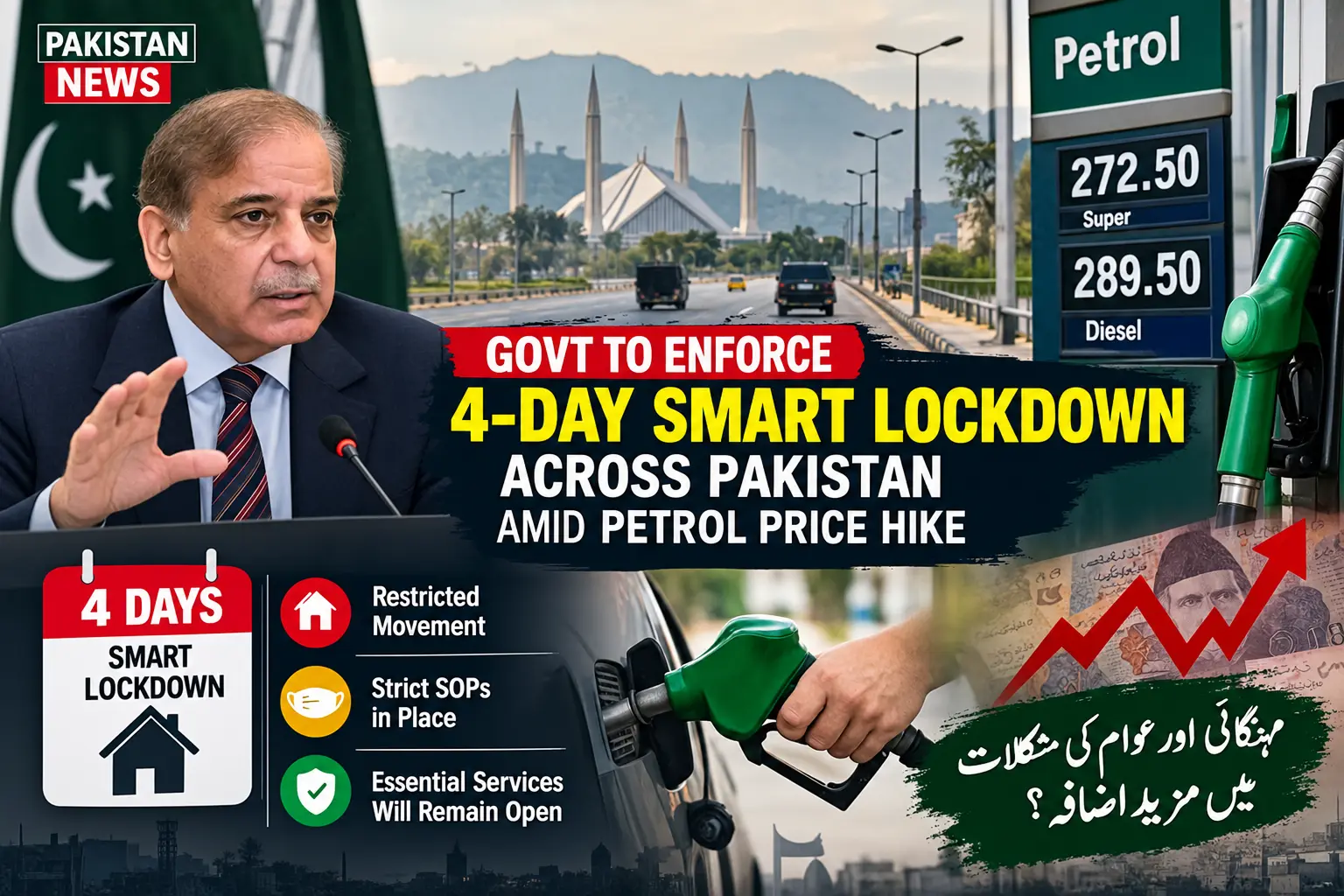
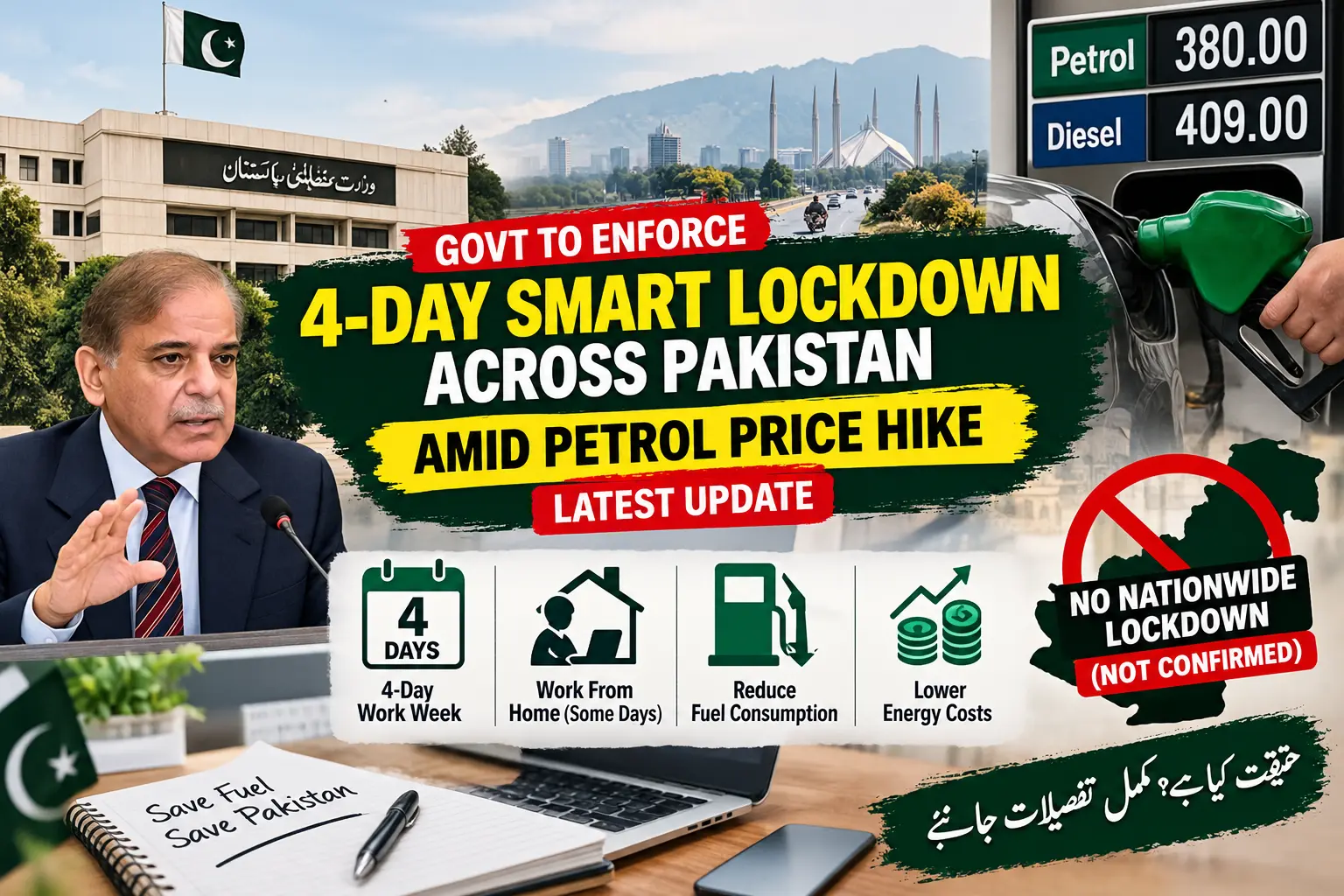
Govt to Enforce 4-Day Smart Lockdown Across Pakistan Amid Petrol Price Hike: Latest Update
As petrol prices in Pakistan rise in September 2026, the federal government is considering implementing a four-day working week, referred to as a smart petroleum lockdown, to reduce fuel and energy costs. This proposal was noted in a government meeting on September 14, 2026, and a formal notification is expected soon, although none has been issued yet. It’s important to distinguish between a four-day work week and a nationwide lockdown; the discussion is currently focused on adjusting the work schedule, not enforcing movement restrictions. The article aims to clarify the situation and guide readers on verifying claims found online.
ستمبر 2026 میں پاکستان میں پیٹرول کی قیمتوں میں اضافے کے ساتھ ہی، وفاقی حکومت ایندھن اور توانائی کی قیمتوں کو کم کرنے کے لیے چار روزہ ورکنگ ہفتہ، جسے “اسمارٹ پیٹرولیم لاک ڈاؤن” کہا جاتا ہے، نافذ کرنے پر غور کر رہی ہے۔ یہ تجویز 14 ستمبر 2026 کو ہونے والی ایک حکومتی میٹنگ میں نوٹ کی گئی تھی، اور جلد ہی باضابطہ نوٹیفکیشن متوقع ہے، حالانکہ ابھی تک چار دنوں کے درمیان کوئی اہم کام جاری نہیں کیا گیا ہے۔ اور ملک گیر لاک ڈاؤن؛ بحث فی الحال کام کے شیڈول کو ایڈجسٹ کرنے پر مرکوز ہے، اس مضمون کا مقصد صورتحال کو واضح کرنا اور آن لائن پائے جانے والے دعووں کی تصدیق کے لیے قارئین کی رہنمائی کرنا ہے۔
Is Pakistan Really Imposing a 4-Day Smart Lockdown?
What the government has proposed
In mid-September 2026, multiple Pakistani outlets reported that the federal government is considering transitioning to a four-day workweek for public and private offices, schools, and universities in response to rising petroleum prices, aiming to cut fuel costs and reduce expenditures. Under this plan, some staff would work from home on specified days, with details left to individual departments. Previously, in March 2026, the government had already implemented a four-day workweek for its offices as part of a “war austerity plan” due to increased regional tensions and fuel costs. This earlier plan included a 50% work-from-home policy, reduced government vehicle use, lower speed limits, and voluntary salary cuts for high-earning senior officers. However, the September proposal is still being considered, unlike the confirmed March measures.
What has actually been approved?
- Status Ladder: Proposed → Under consideration → Approved → Implemented.
- March 2026: Four-day workweek and austerity package implemented via Cabinet Division notification.
- September 2026: Four-day workweek linked to petrol price hike decided in principle; departments preparing revised schedules, but not formally announced to the public.
- Nationwide “Smart Lockdown” Claims: Unverified claims of a lockdown circulated on social media, but no official confirmation as of mid-September 2026.
Status Box (as of September 15, 2026)
| Item | Status |
| Latest reported policy | Four-day work week tied to fuel-cost savings |
| Nationwide lockdown (movement/market restrictions) | Not confirmed |
| Formal notification | Not yet issued (reportedly “expected soon”) |
| Basis | Minutes of a government meeting held September 14, 2026 |
| Best source to check for updates | Cabinet Division / Ministry of Information official channels |
Different reports use terms like four-day work week, smart petroleum lockdown, and full weekend lockdown for a situation. The term smart lockdown should be used cautiously, as it refers to localized restrictions in Pakistan, not a nationwide shutdown.
Why Is the Government Considering a 4-Day Work Week?
Rising petrol and diesel prices
Fuel prices in Pakistan have steadily increased in the second half of 2026, with petrol reaching Rs 380 per litre and diesel Rs 409 by mid-September. Earlier, prices peaked at Rs 458.41 for petrol and Rs 520.35 for diesel in April due to a regional oil-market shock. Despite temporary government cuts, prices are rising again, affecting transport fares and household budgets, which keeps fuel conservation in policy discussions.
Fuel conservation is the underlying logic
The rationale for a shortened workweek is to reduce commuting days, which can lead to decreased fuel consumption for vehicles, lower demand for public transport during peak hours, reduced government vehicle fuel usage, and lower office utility costs. This approach was previously implemented in Pakistan during the March 2026 austerity drive, linking it with measures like reduced government vehicle usage and remote work to conserve fuel. It is a recurring strategy in response to rising petroleum costs and supply pressures.
4-Day Work Week vs Smart Lockdown: What’s the Difference?
These terms are often used synonymously in headlines and WhatsApp forwards, yet they refer to distinct concepts.
| Policy | Meaning | Main purpose | Who is affected? |
| 4-day work week | Offices and institutions operate four days instead of five or six | Reduce commuting and fuel use | Government/private employees, students |
| Smart lockdown | Targeted restrictions in specific areas or sectors, not a full shutdown | Reduce movement or energy use in high-impact zones | Businesses and public in affected zones |
| Weekend restrictions (proposed in some reports) | Reduced activity on Saturday/Sunday | Cut fuel and energy consumption | Businesses, markets, event venues |
| Complete lockdown | Broad closure of most activity | Maximum movement reduction (typically a public-health measure) | Almost everyone |
Several distinct proposals have emerged in recent news, causing confusion between a four-day work week, energy-saving notifications, and health-related lockdown measures. A four-day work week is a scheduling change and does not restrict movement or commerce, unlike a lockdown that closes markets and limits travel. These two concepts are not interchangeable, and no nationwide lockdown has been confirmed as of now.
What Restrictions Could Be Imposed Under Any Smart Lockdown?
There is currently no confirmed nationwide lockdown for September 2026, but understanding past smart lockdown measures is useful.
- Markets and Shopping Malls: Previous notifications often set earlier closing times (around 8:00 PM) instead of complete closures.
- Offices: Measures included four-day workweeks, hybrid schedules, and reduced attendance (e.g., 50% attendance rule).
- Schools and Universities: Education schedules may be adjusted separately, so it’s important to check specific institutions’ notifications.
- Wedding Halls and Gatherings: Previous restrictions included caps on guest numbers (e.g., 200 guests) and limits on late-night events.
- Essential Services: Hospitals, pharmacies, and other essential services have always been exempt from lockdown measures.
| Sector | Possible measure | Status (Sept 2026) |
| Government/private offices | Four-day week / hybrid work | Reported, not yet formally notified |
| Markets | Earlier closing hours | Not confirmed nationally |
| Malls | Reduced hours | Not confirmed nationally |
| Schools | Schedule adjustments | Handled separately by provinces |
| Hospitals | Normal/essential operations | Exempt in past measures |
| Pharmacies | Normal/essential operations | Exempt in past measures |
| Public transport | Any restriction requires a separate decision | Pending |
Treat the listed items as possibilities based on past patterns rather than confirmed rules for the current proposal, until an official notification indicates otherwise.
Petrol Price Hike: Why Fuel Costs Are Behind the Policy
Latest reported petrol price in Pakistan
- As of September 16, 2026, petrol is approximately Rs 380/litre and high-speed diesel is approximately Rs 409/litre in Pakistan.
- Fuel prices are reviewed by the Oil and Gas Regulatory Authority (OGRA) on a fortnightly basis.
- Pricing factors include international crude prices, refining and freight costs, and the exchange rate of the rupee.
- Prices can vary across different outlets, so it’s important to confirm current rates through OGRA’s official notifications.
How do higher petrol prices affect Pakistan?
- Rising fuel costs lead to increased transport fares and ride-hailing expenses. This results in higher freight and logistics costs, driving up prices for food and goods. Businesses relying on transportation or diesel equipment face elevated operating costs, putting pressure on household budgets as commuting and everyday expenses rise. Overall, inflationary pressure increases.
Why a four-day week could reduce fuel consumption
Authorities aim to reduce petrol demand by cutting commuting days for many in the government and private sectors, which will help lower household fuel costs and decrease the country’s import expenses for refined petroleum products.
Pakistan Fuel-Policy Timeline, 2026
- March 9–11, 2026: Prime Minister Shehbaz Sharif announces a “war austerity plan” due to regional tensions and rising fuel costs, implementing a four-day workweek for federal offices, along with reduced vehicle use and salary cuts for senior officials.
- Late March 2026: Provincial governments introduce similar austerity measures, including reduced vehicle allowances and expanded work-from-home policies.
- March 29, 2026: A proposed two-day “smart lockdown” is discussed, suggesting restrictions from Saturday noon to Sunday midnight, pending provincial agreement.
- Early April 2026: Petrol and diesel prices reach record highs (Rs 458.41 and Rs 520.35 per litre), prompting the government to later issue relief cuts.
- Mid-2026: Provinces implement periodic smart lockdown notifications, focusing on targeted, hourly restrictions rather than full market closures.
- September 14–15, 2026: Reports indicate a renewed decision to pursue a four-day workweek due to rising petrol prices, with a formal notification expected soon.
This timeline will be updated as more confirmed information is released.
Read ALso: Rs 100 Petrol Subsidy Pakistan: 9771 Registration & Eligibility
Province-Wise Response to the Policy
As of mid-September 2026, no fresh federal notification has been issued regarding new proposals, leading to varying provincial responses:
- Punjab has quickly implemented measures such as adjusting vehicle allowances and experimenting with four-day school weeks.
- Sindh plans to consult the business community, specifically in Karachi, before deciding on early market closures, indicating that provincial agreement may not be prompt.
- Khyber Pakhtunkhwa has independently approved its Fuel Conservation and Responsible Governance Initiative, which includes cuts to vehicle allowances and a partial work-from-home policy.
- Balochistan and Islamabad/the federal government typically follow federal schedules based on Cabinet Division notifications.
Because provincial responses may differ, verify each province’s official notification rather than assume a uniform approach.
Will Schools Be Closed?
The text emphasizes that provincial education departments often manage school and university schedules separately from general office announcements. Changes like the implementation of a four-day school week may occur independently of office attendance rules. Therefore, it is important to seek specific notifications from educational institutions rather than assuming they align with office-related updates.
Will Offices and Businesses Be Closed?
- Government Offices: A confirmed four-day workweek starting in March 2026, with a proposed similar schedule for September 2026 (not yet formally notified).
- Private Offices: No mandated shift to a four-day week; some incentives for work-from-home participation due to austerity packages.
- Markets and Shopping Malls: No nationwide closure or fixed early-closing times confirmed; some provinces have previously imposed evening closing times.
- Restaurants and Wedding Halls: Past limitations on guest numbers and timing under austerity, but no specific restrictions are confirmed for the September 2026 proposal.
Always categorize updates as confirmed, proposed, or exempt.
Is the Viral Lockdown Notification Real?
Social media posts are spreading claims about a nationwide smart lockdown related to a Gulf oil crisis, but there is no official government notification to support these claims. It’s important to verify such information before sharing or acting on it.
How to verify an official notification
To verify information, check with the following sources:
- The Cabinet Division / Ministry of Information official announcements
- The Prime Minister’s Office
- Your relevant provincial government’s official notifications
- Verified official government social media accounts
- Established national news outlets that reference a specific notification number and date.
Don’t rely on WhatsApp screenshots or unverified posts
A screenshot or forwarded message cannot be considered proof of government policy. In Pakistan, there have been instances of unverified lockdown claims circulating quickly. If a notification lacks a specific document number, issuing department, and date, it should be treated as unconfirmed until the source is verified.
What Will Happen to Petrol Prices?
Predicting future petrol prices is not possible due to factors like international crude oil movements, Pakistan’s exchange rate, and OGRA’s pricing decisions. In 2026, prices fluctuated significantly, ranging from nearly Rs 458/litre in early April to around Rs 370–380/litre by mid-September. For the most accurate and up-to-date prices, consult OGRA’s official notifications rather than relying on this article.
What Should Citizens Do?
- Employees: Adjust commute plans based on schedule changes, inquire about work-from-home options, and consolidate errands to save fuel.
- Students: Verify school or university schedules through official notices and avoid relying on unverified social media information.
- Businesses: Follow provincial government updates and make staffing or hour adjustments only after official confirmation.
- Motorists: Keep track of petrol and diesel prices, minimize unnecessary travel, and consider carpooling or public transport to manage fuel costs.
What Happens Next?
- Look for a formal Cabinet Division notification regarding the four-day work week.
- Monitor provincial governments’ responses and notifications.
- Keep an eye on updates to school and university schedules from education departments.
- Watch for the next OGRA petrol and diesel price notification.
- Look out for announcements related to market hours or public gatherings.
- The article will be updated with new official information, and readers are encouraged to check official sources directly for time-sensitive decisions.
Frequently Asked Questions
Is Pakistan imposing a 4-day smart lockdown?
As of September 15, 2026, no nationwide lockdown has been officially confirmed. Reports indicate the government is considering a four-day work week tied to fuel-cost savings, with a formal notification described as pending.
When will the 4-day work week start in Pakistan?
No confirmed start date has been officially notified for the September 2026 proposal. A similar four-day workweek was formally implemented for federal offices in March 2026.
Why is Pakistan introducing a four-day working week?
The stated reason is to cut fuel, electricity, and administrative costs amid continuing increases in petroleum prices.
Will schools be closed during any new work-week change?
Not automatically. School and university schedules are generally handled separately by provincial education departments; check your specific institution’s notices.
Will markets and shopping malls remain open?
As of now, no nationwide closure of markets or malls has been confirmed under the current proposal. Some provinces have previously set earlier closing hours through separate notifications.
Is the Pakistan lockdown notification on social media genuine?
Treat any viral notification with caution unless it cites a specific document number, date, and issuing government department and is corroborated by an established news outlet or official government channel.
Why are petrol prices increasing in Pakistan?
Prices are driven by international crude oil markets, the rupee’s exchange rate, and periodic OGRA pricing revisions, which have pushed rates higher through much of September 2026.
Conclusion
Pakistan is considering a shortened, four-day working week as a cost-saving measure due to recent fuel price hikes, following a similar initiative taken in March 2026. However, as of now, this proposal is not officially confirmed, and there is no nationwide lockdown. It is advised to rely on official notifications rather than social media for accurate information regarding any new restrictions and to stay updated as the government’s decision progresses.
ایندھن کی قیمتوں میں حالیہ اضافے کے پیشِ نظر، پاکستان اخراجات میں بچت کے اقدام کے طور پر ہفتہ وار کام کے دورانیے کو کم کر کے چار دن کرنے پر غور کر رہا ہے؛ اس سے قبل مارچ 2026 میں بھی ایسا ہی اقدام کیا گیا تھا۔ تاہم، فی الحال اس تجویز کی باضابطہ تصدیق نہیں ہوئی ہے اور ملک بھر میں کوئی لاک ڈاؤن نافذ نہیں ہے۔ مشورہ دیا جاتا ہے کہ نئی پابندیوں سے متعلق درست معلومات کے لیے سوشل میڈیا کے بجائے سرکاری اعلانات پر انحصار کیا جائے اور حکومتی فیصلے کے حوالے سے تازہ ترین صورتحال سے باخبر رہا جائے۔
Disclaimer
The article is intended for general informational purposes, summarizing news up to September 15, 2026. It emphasizes that government policies, fuel prices, and official information can change quickly and should not be considered official communication or legal/financial advice. Readers are advised to verify time-sensitive information, such as lockdown status and fuel prices, through official government sources before making any decisions.
Sources & References
- The Pakistani government is implementing a four-day smart lockdown in response to rising petrol prices, according to various sources in September 2026.
- In March 2026, the government also notified a four-day workweek for offices as part of a “war austerity plan” to address the energy crisis.
- Multiple news outlets reported on the immediate effect of the four-day workweek notification aimed at conserving fuel amid ongoing economic challenges.
- The government is considering further measures, such as a two-day weekly smart lockdown, to reduce energy consumption.
- Readers are advised to verify any updates on fuel prices and lockdown measures through official channels like OGRA and the Cabinet Division, as some information may come from secondary sources.